Registered Chinese name北京他山科技有限公司Beijing Tashan Technology Co., Ltd.
Tashan Technology focuses on the research and development of AI tactile sensing technology and application solutions. The company was founded in 2017 and brings together senior R&D…
TS-V visual-touch integration training platformTS-VT visual and touch fusion training platform (data collection)tactile simulationEmerald chip E10A
Tashan Technology focuses on the research and development of AI tactile sensing technology and application solutions. The company was founded in 2017 and brings together senior R&D team elites from top universities such as Tsinghua University and the University of Manchester. After years of accumulation, Tashan Technology has solved the global technical problem of simultaneous analysis of multi-dimensional tactile sensing signals in the tactile sensing algorithm, built a complete technical system of "chip-sensor-algorithm model-scenario application", and was rated as a national-level specialization "Key Little Giant".
In the field of humanoid robots, it is mainly used in scenes such as robot fingertip tactile sensors and electronic skin, and is widely used in automobiles, home appliances, consumer electronics and other fields. At present, Tashan Technology has reached in-depth commercial cooperation with more than 160 domestic and foreign robot industry chain customers, including humanoid robot manufacturers such as Zhiyuan Robot, Galaxy Universal, and Independent Variable, and dexterous hand companies such as Yinshi Robot, Qiannao Technology, and Lingxin Shou.
02
MAIN PRODUCTS
Key Products
05 ITEMS
01
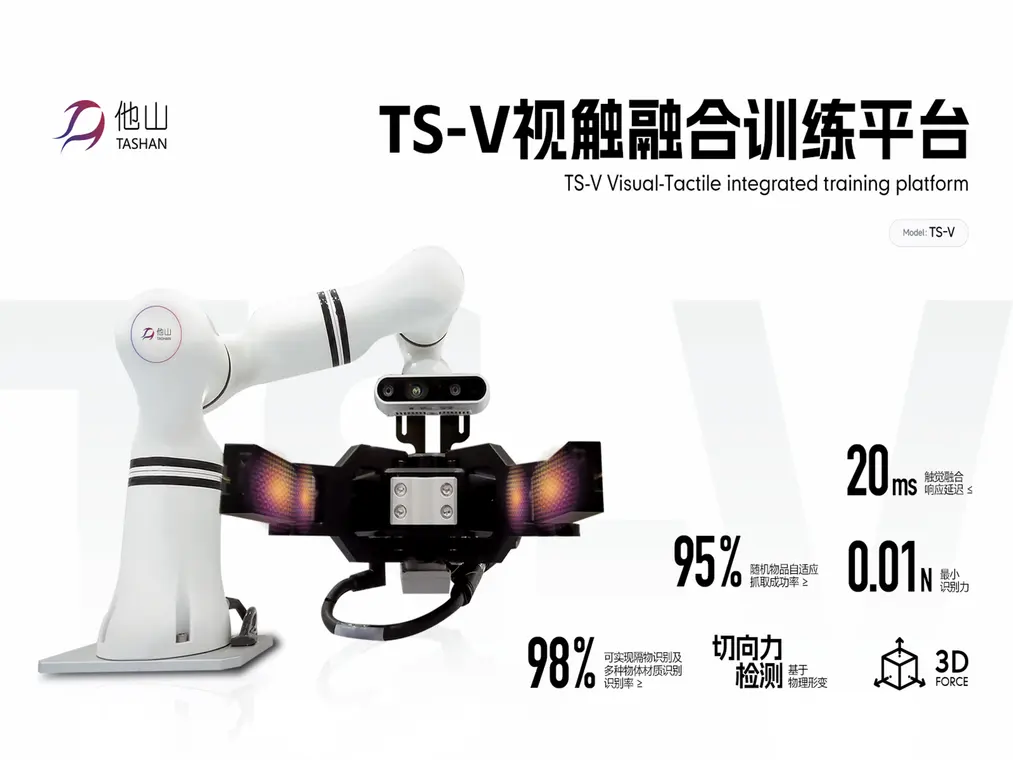
TS-V visual-touch integration training platform
Integrating visual and tactile multi-modal sensing technology enables the robot to stably grasp any object in complex scenes. The system supports real-time sensing of contact status and force application, adaptive control of gripper movements, and more robust, supple, and generalized grasping.
02
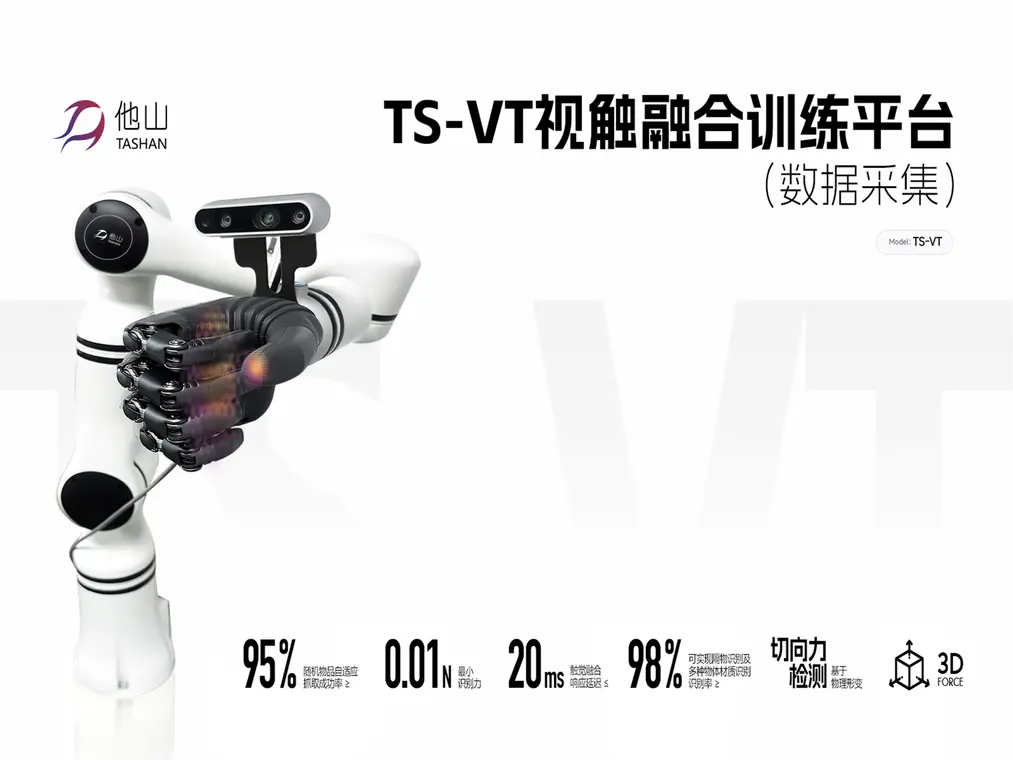
TS-VT visual and touch fusion training platform (data collection)
Provides professional multi-dimensional tactile data recording, annotation and export functions, and is suitable for a variety of end effectors such as dexterous hands and grippers. Users can easily collect data such as three-dimensional force, proximity sense, and contact point changes, which greatly reduces the cost of data collection and provides a reliable basis for training tactile perception algorithms and evaluating robot interaction performance.
03
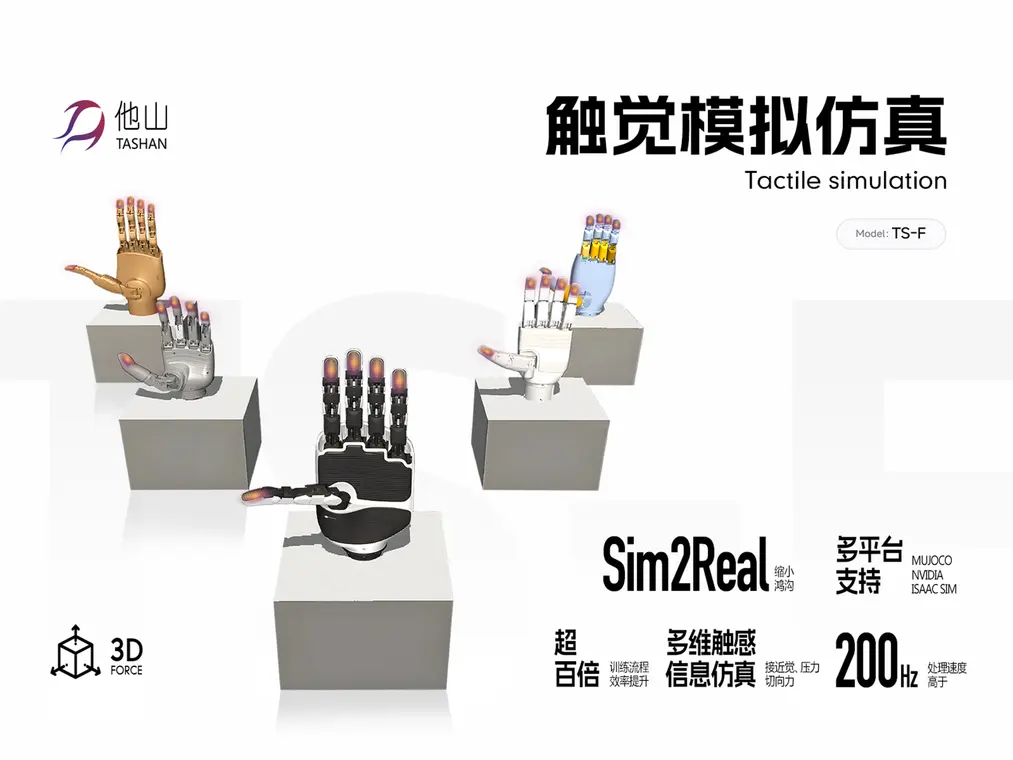
tactile simulation
Tashan Technology's tactile simulation realizes a complete closed loop from tactile contact simulation, real-time visualization of data curves, to tactile modal modeling training. It accurately restores the real tactile information of Tashan Technology's tactile sensors and narrows the difference between Sim2Real. It is an important tool to promote the implementation of tactile sensing.
04
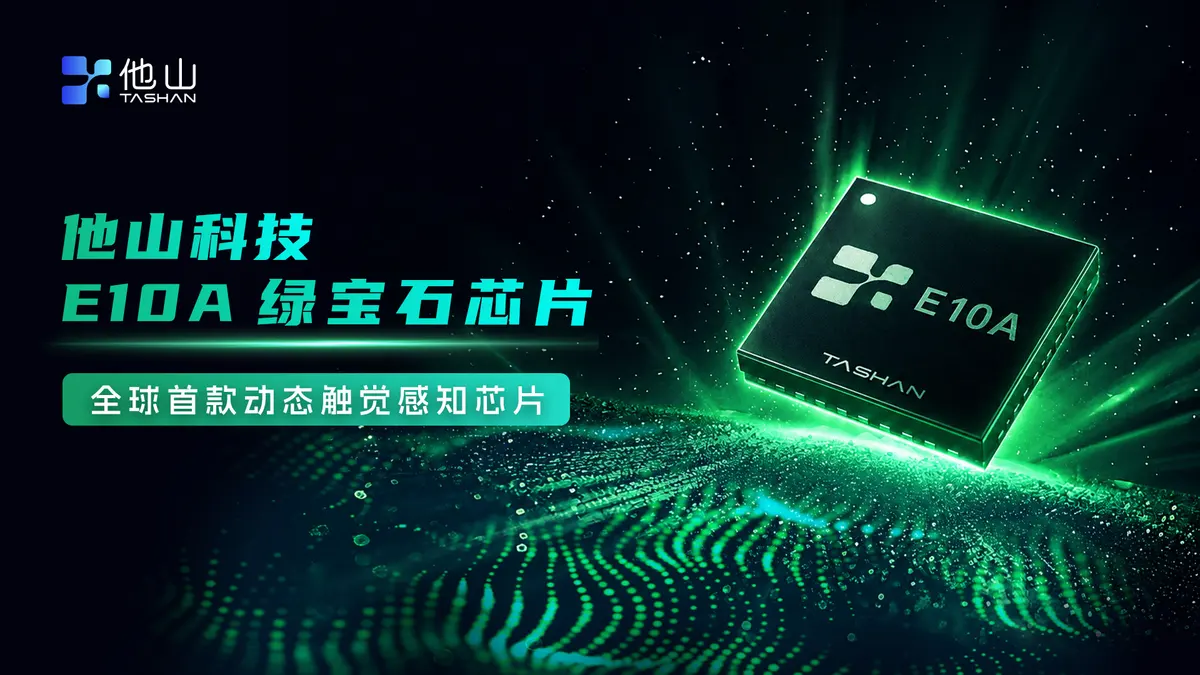
Emerald chip E10A
Tashan Technology E10A Emerald is the world's first dynamic tactile sensing chip and the first chip that directly converts tactile signals into pulse signals through ASC. It can realize event-driven and sparse calculations, achieve microsecond-level time resolution and ultra-low power consumption operation. With breakthrough functions of low latency, low power consumption, and near wake-up, it improves safety and tactile response speed, enabling robots to move from local touch to full-body sensory control integration.
05
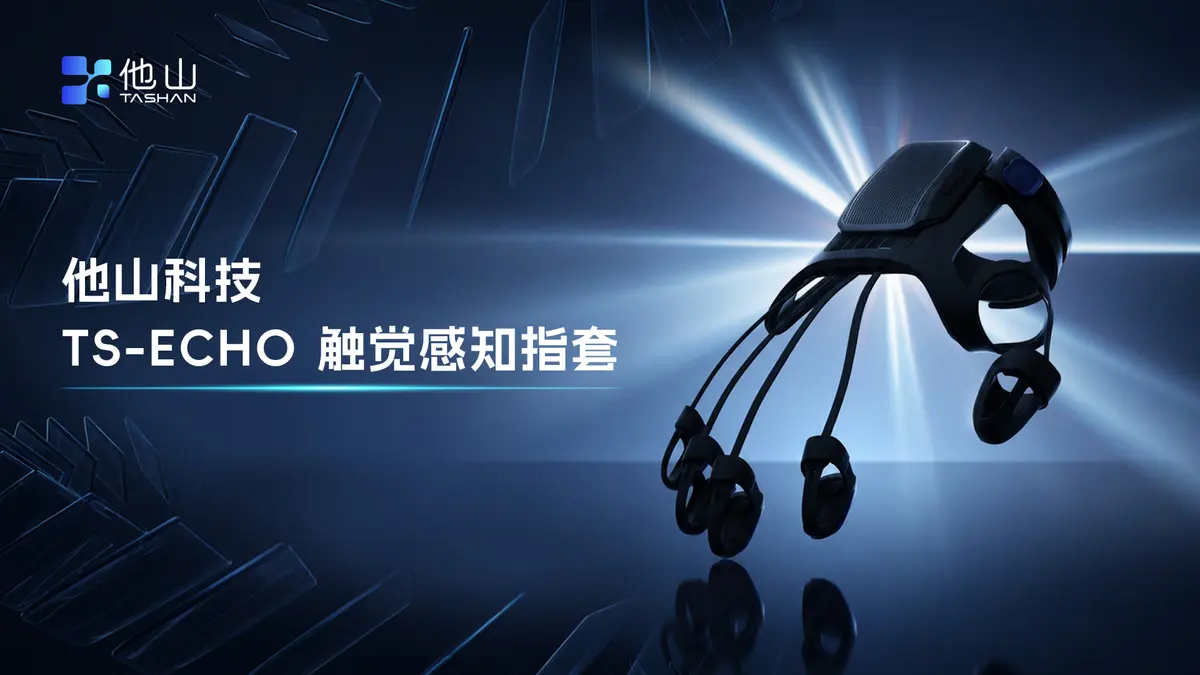
TS-ECHO tactile sensing finger cot
Through lightweight tactile finger cots, the contact, force, slip and interaction states during human operation are transformed into high-quality data that can be trained, synchronized, and annotated, and supports fusion collection with vision, movement, language and other modalities. The system is suitable for cutting-edge directions such as robot operation learning, world model and VTLA, helping robots move from "seeing the world" to "truly understanding the physical world".